The argument
Most development experts — neoliberal economists and Marxist scholars alike — share a single end goal: industrialization, urbanization, technological advancement, accumulation. Call it GUTA: Gigantism, Urbanization, Technology-for-technology's-sake, Accumulation.
Small Steps argues that the places that have most consistently lifted people out of poverty have often done the opposite. They have chosen sufficiency over accumulation, community scale over urbanization, appropriate technology over high-tech, and accessible opportunity over efficient extraction. The result is rarely impressive on GDP scorecards. It is, however, far more reliable at funneling the benefits of economic activity into the pockets of poor families.
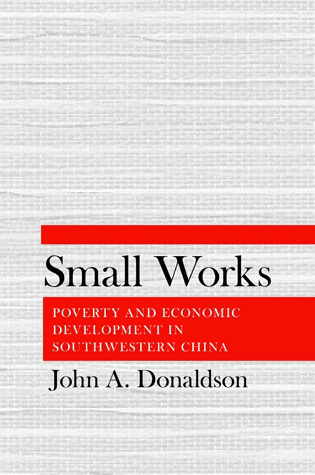
The previous book
Small Works: Poverty and Economic Development in Southwestern China
Cornell University Press, 2011
The book that grew out of the Guizhou puzzle — and that Small Steps extends well beyond China.
The new book builds on the Guizhou fieldwork of Small Works — drawing out a coherent alternative from a set of cases that have, until now, mostly been treated as unrelated exceptions.
Chapter anchors
Four country cases anchor the book, each illustrating a different facet of sufficiency-first in practice:
- Barbados — inclusive tourism development as a sustained national strategy
- Singapore — appropriate technology (low-tech, locally fixable) and cottage industries, alongside the better-known high-tech story
- Switzerland — community-scale rural and urban development
- Bhutan — sufficiency chosen over accumulation
Other cases
Supporting cases include Kerala's long path of human development, Ethiopia's Productive Safety Net Programme, Costa Rica's cooperatives, and Somaliland's Zaad mobile-money system. Each illustrates a different way sufficiency-first has been pursued — or, importantly, the conditions under which it has not.
A distinction that matters
The book makes a central distinction between chosen policy sufficiency and forced sufficiency. The former is a deliberate orientation — Bhutan's Gross National Happiness, Switzerland's federal protection of small-scale forms. The latter is what happens when communities have no other choice, and it is not what Small Steps advocates. The argument is not that smallness is intrinsically virtuous; it is that, where chosen and supported, sufficiency-first strategies have an under-appreciated track record of reducing poverty.
"Poor people benefit more when you generate opportunities that are small in scale and low-tech. As a prescription, that's pretty obvious. It also flies in the face of nearly everything development experts recommend."
Where things stand
The manuscript is in active development. A six-continent research trip in 2025–2026 visited many of the cases above; the resulting fieldwork is feeding directly into the book. Readers interested in following the work in progress can subscribe to the newsletter below.